Hearing a Woodpecker and Finding Your Own Meaning
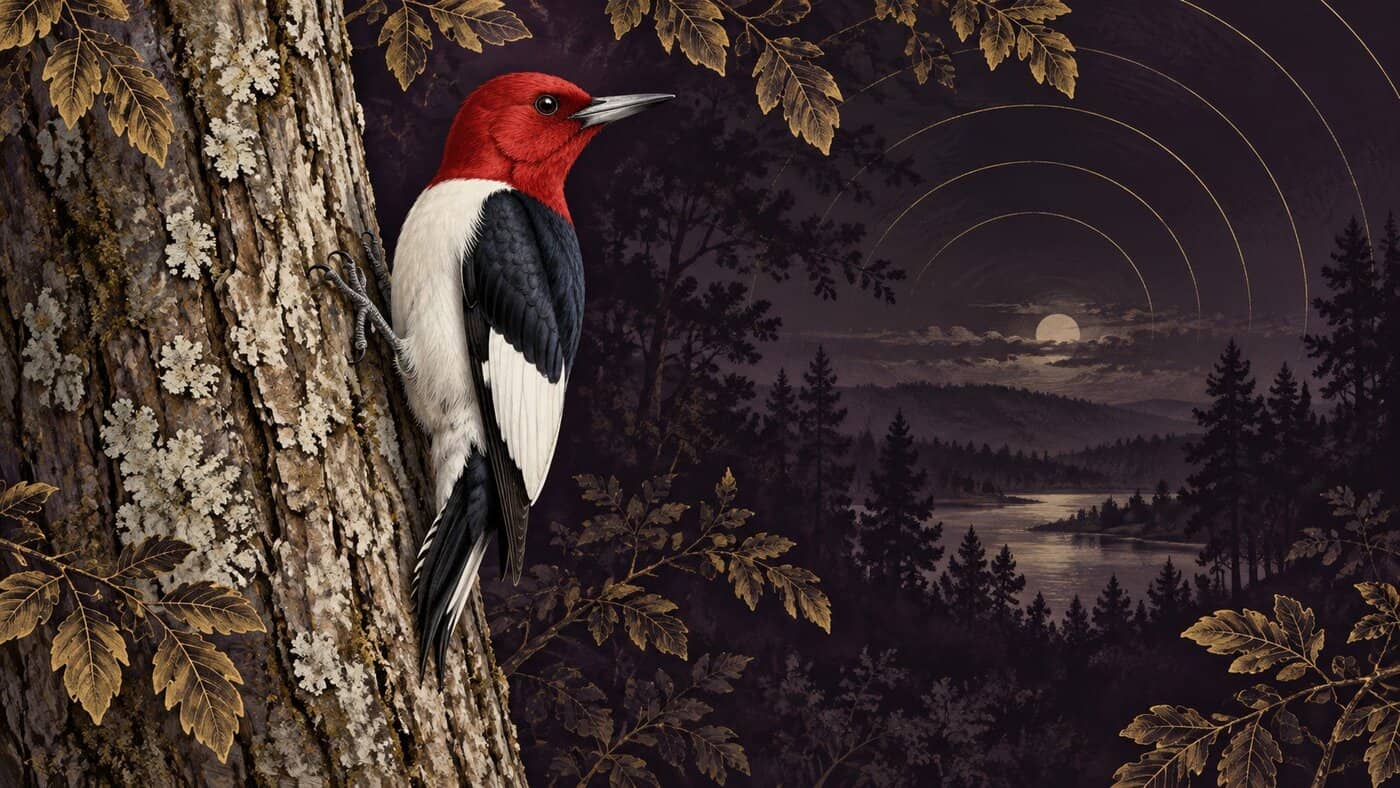
Hearing a woodpecker can become a personal symbol of persistence, attentive listening and the pleasure of noticing nature. Seeing a red-headed woodpecker may add an association with courage or creativity. I like those possibilities as prompts for reflection, while remembering that the bird is living its own life, not delivering a prediction about mine.
That sudden tapping can feel like a tiny pep talk on a flat morning. Oops, maybe I am guessing too much. The encouragement belongs to the meaning we give the moment, and it can still be welcome.
What the tapping is doing in the bird's world
It helps to listen with curiosity before trying to translate every sound. Woodpeckers can make noise while feeding or working on a cavity, and drumming is also communication. Cornell's guide to red-headed woodpecker sounds describes drumming that helps defend territory and slower tapping near a nest used in communication between mates.
That distinction gives the metaphor more room. A sound that reminds you of effort might be a prompt to keep going; a communication rhythm might make you think about something you need to say. Neither interpretation tells you what the bird intends for you.
Listen from a respectful distance. You do not need to approach a nest, touch a wild bird or make it respond to have a meaningful encounter. Let your breathing remain comfortable and natural; a fast drum is not a rhythm to copy with your breath.
Persistence without pushing yourself past every limit
The image of a woodpecker returning to its work can make a difficult task feel less overwhelming. I would turn that into one manageable step: send the message, open the notebook or spend a little time practising. A small repeatable effort can feel more useful than a grand promise.
Persistence also leaves room to change your approach. If something is hurting you or another person has set a boundary, “keep tapping” is the wrong lesson. You can stop, rest, ask for help or choose another direction. Nature does not obligate you to stay in a harmful situation.
In our spiritual meaning collection, animal encounters offer starting points for reflection, not rules for your life.
The related reflection on osprey symbolism and focused attention offers another bird image for considering when to act. Let the comparison open a question, rather than using either sighting to make the decision for you.
Seeing a red-headed woodpecker
A flash of red can be the detail that stays with you. If red feels bold or creative to you, ask where you would like to speak more clearly or give an idea a little space. That is a personal colour association, not evidence that your instincts must be right.
There is also a specific bird called the Red-headed Woodpecker. Adults have an entirely red head, a white underside and striking black-and-white wings. Many other woodpeckers have some red on the head, so a red patch alone does not identify this species. Cornell's Red-headed Woodpecker overview includes identification images and a range map.
Red-bellied and pileated woodpeckers are different birds. You do not need to give each one a separate spiritual rule to appreciate what you saw. Nor does a sighting tell you that a bird is female and therefore carries “nurturing energy.” Observe what you can actually see, and leave room for not knowing.
Whether a sighting is unusual depends on your location and the habitat. The American Bird Conservancy's species account describes the red-headed woodpecker's life and conservation needs. Learning about the real bird can make the moment richer than calling it a rare omen.
Love, communication and personal guidance
A repeated rhythm can remind you that relationships depend on everyday attention. Perhaps the useful action is listening without planning your reply, saying something plainly or following through on a small promise. Those are choices you can check against real life.
If you use the language of twin flames, the bird might become an image for honesty or patience. It cannot tell you what someone feels, confirm a destined partnership or justify contacting someone who has asked for distance. A loving interpretation should leave both people free.
Some readers call a meaningful animal an inner guide or spirit animal. Here, I mean a personal image that helps you think. I am not presenting a shared teaching from all Indigenous peoples or assigning a universal Celtic, Buddhist or biblical meaning to the sound. Specific traditions deserve specific sources and context.
Woodpeckers in dreams and small signs you notice
In a dream, was the tapping comforting, irritating or impossible to ignore? Were you watching the bird, looking for it or trying to protect a tree? Your reaction may tell you more about the dream's personal associations than a list of fixed symbols.
A black-and-white bird might make you think about contrasting choices; a red head might stand out as a vivid detail. A feather might bring lightness or a remembered encounter to mind. You can photograph what you notice and leave it where it is. None of these images establishes a future event.
For a wider comparison, bird dream symbolism explores how different scenes can change the question you bring to a dream.
One question, one action
The simplest practice I would keep from this encounter is a short note. Write down what you actually noticed, then separate that observation from the meaning you are considering.
- Observation: “I heard tapping while I was thinking about a project.”
- Question: “Which part of my life could use a bit more care right now?”
- Action: “I will work on one paragraph,” or “I will ask for the help I need.”
You could instead write one thing you appreciated, or let yourself enjoy a little movement if it feels comfortable. There is no required number of knocks, no special sequence and no need to turn the moment into homework.
Sometimes the best response is to stay still for another minute and listen. The bird can keep its own purpose while you enjoy having noticed it.
Questions about woodpecker symbolism
What is the spiritual meaning of hearing a woodpecker?
You might take its rhythm as a personal reminder of persistence, attention or clearer communication. The sound is natural bird behaviour, not a coded instruction or proof that an event is about to happen.
What does seeing a red-headed woodpecker mean spiritually?
Its striking red head may bring courage, creativity or fresh energy to mind. Those are personal associations. The sighting does not guarantee good luck, confirm an intuition or predict a new beginning.
What does a woodpecker mean for love or twin flames?
It can be a useful image for patient listening and consistent care. A bird cannot establish that someone is your twin flame, reveal their feelings or promise a reunion; look to consent and actual communication.
Does a woodpecker have a biblical message?
This guide does not assign a biblical prophecy to a woodpecker sighting. If the encounter prompts prayer, treat that as your own response rather than claiming scripture gives the bird a fixed message.
What might a woodpecker in a dream mean?
Consider the sound, the setting and your own feelings. Repeated tapping might remind you of a task asking for attention, while watching a bird could bring curiosity or freedom to mind. Dreams have no single guaranteed translation.